
Artist Citizen
05/27/08
In the 1840s and '50s, hundreds of thousands of Irish, German and Italians immigrated to the United States fleeing famine and political turmoil. Among the Italians was a very accomplished artist, Constantino Brumidi, an acquaintance of Pope Pius IX, the pontiff who would switch the Vatican's focus from political involvement to doctrine, devotion and philosophy.
Pius IX had sprung Constantino from prison in which he had landed for being on the wrong side of a revolution. The pardon enabled Constantino to come to the U.S. in 1852, ready to decorate churches and pick up whatever other commissions he could.
Anti-immigrant and anti-Catholic feeling in the U.S. was higher than usual in the 1850s. Nevertheless Catholic dioceses and religious orders unabashedly built new churches in swelling U.S. cities. Constantino supplied paintings for a number of these including two Jesuit installations, St. Ignatius Church (1856) on Calvert St. in Baltimore and St. Aloysius Church (1859) on North Capitol St. in Washington, DC. His other projects included a proposal for building elevated railroads above the teeming traffic-choked streets of New York City.
However Constantino's biggest and longest-running commission took place several blocks south of St. Aloysius. By the 1850s, the growth of the country had necessitated the expansion of the U.S. Capitol Building. Under construction were two huge wings containing larger Senate and House of Representatives chambers. In the works was a plan for a new Capitol dome, the nine-million-pound, cast-iron structure that is now recognized the world over.
In charge of the Capitol was Secretary of War Jefferson Davis. His Superintendent of Construction was an army engineer who would leave many marks on Washington, DC, Montgomery C. Meigs. Meigs had Constantino do one little fresco at the Capitol. Davis and Meigs liked the fresco so much they put Constantino on the payroll. He would work at the Capitol until his death in 1880.
Inspired by the art of the early persecuted Christians in Roman catacombs, Constantino decorated the halls of the Senate wing in similar fashion. However instead of saints and martyrs, he depicted American plants and animal species. His fresco of "Religion" represented by a woman wearing a cross and holding a bible looks an awful lot like a madonna. He managed to get a Catholic priest into a painting in the Senate Indian Affairs committee room, Bartolomeo de Las Casas OP, who denounced both slavery and mistreatment of New World peoples. Today Constantino's most accessible Capitol works can be seen in The Rotunda, the Apotheosis of George Washington in the dome ceiling, and the frieze of American History running around the base.
You can imagine what happened when members of the anti-immigrant, anti-Catholic American Party (aka "Know Nothings") found out that a Catholic immigrant was painting the U.S. Capitol! There were complaints about the foreign-style decoration and efforts to restrict commissions to American artists. Yet Constantino and his allies weathered them all until the start of the Civil War pushed the controversy into the background.
In 1857, Constantino became a U.S. citizen and he proudly signed his latest fresco, "C Brumidi Artist Citizen of The U.S."
"My one great ambition and my daily prayer," he said, "is that I may live long enough to make beautiful the Capitol of the one country on earth in which there is liberty."
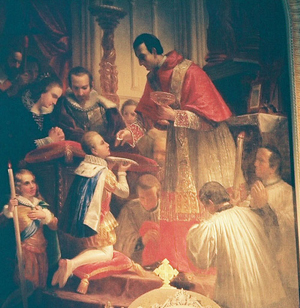
- Above: Brumidi's Altar piece at St. Aloysius Church near the U.S. Capitol. The scene depicts St. Aloysius receiving his First Communion from St. Charles Borromeo. The model for Aloysius' mother (at left) was Adele Cutts Douglas, wife of Stephen Douglas who ran against Abraham Lincoln for the Senate (Lincoln-Douglas debates) and the Presidency.
- About this site and Neal J. Conway